
• Skip to primary navigation
  • Skip to content

Debra Kasowski

  • Home
  • About
  • Podcast & Blog
  • Retreats
  • Work with Debra
    • Speaking
    • Coaching
    • Workshops/Course
  • Media
  • Connect

3 Ways to Establish Boundaries in Business

July 3, 2016 by Debra Kasowski Leave a Comment

Sometimes the term “boundary” receives a negative connotation due to a meaning a limit and restriction. Boundaries are necessary in business in order to be more effective and productive with their time, money, and resources. Business owners often think that potential and current customers will be read held by a company or organization that has boundaries; however, this is not true.

“Time is the most valuable coin in your life. You and you alone will determine how that coin will be spent. Be careful that you do not let other people spend it for you.”
― Carl Sandburg

Here are three ways that you can get started by establishing boundaries in your business:

Set office hours. An open door policy is great but it can also take up a lot of time when conversations are more social rather than about business. Connecting with people is important however consider having a time limit on the social aspect and focus on the business at hand. For anyone working from home, boundaries are important because many people who see you working at home think that you are either not working or have the flexibility to change her schedule at a moment’s notice. Even though you may have the flexibility, you don’t want to fall into the habit of changing up your schedule. You need to stay committed to the time that you block off for yourself and the people you serve. This time blocking technique can also be used to the time set aside for spending time with family and friends and exercise.

Boundaries to consider:

  • Are there any days you block off as days of rest?
  • When do you check and respond to emails?
  • Do you check voicemail messages and answer them on the weekend?

Business is business. Friendship is friendship. You have grown your business to where it is now. You put in long hours may have spent a lot of money and time on training and suddenly people want to start picking your brain and they’re asking for extras. I learned a long time ago that this devalues a person’s worth. Even though you want to help a friend, you do need to set boundaries. You’re in business to make money and not to give away your content and knowledge for free. Chances are the other person will not be sharing or providing their service or product for free. There has to be a win-win otherwise people will take advantage of you. There are ways to create a win-win through volunteering or trading services. It is up to you what you want to share and help with. Remember your worth and value in the marketplace. Teach people how to treat you and when you’re in business you are there to serve but also to make money otherwise is just a hobby.

“The most important distinction anyone can ever make in their life is between who they are as an individual and their connection with others.”
― Anné Linden, Boundaries in Human Relationships: How to Be Separate and Connected

Boundaries to consider:

  • Is sharing your knowledge creating a win-win situation?
  • Are you in business to make money or is it a hobby?
  • Have you set clear expectations between friendship and business?

Learn to say no. You need to set clear expectations about what you are willing and able to do in your business versus what you can do. Just because you have a skill set that doesn’t mean you should be doing it all. Delegation is a key strength to increasing productivity and boosting performance in business. Not only are you saying no to things that you need to stop doing, you are also saying no to activities and tasks that do not utilize your strengths. Focusing on your strengths improve your business.

“if you want to live an authentic, meaningful life, you need to master the art of disappointing and upsetting others, hurting feelings, and living with the reality that some people just won’t like you. It may not be easy, but it’s essential if you want your life to reflect your deepest desires, values, and needs.”
― Cheryl Richardson, The Art of Extreme Self-Care: Transform Your Life One Month at a Time

Boundaries to consider:

  • Is there anything in your business you need to stop doing or delegate?
  • Are there any clients that are not the right fit for your business that you need to let go of?
  • What activities and have are you willing and able to do to best serve your customers or clients?

Setting boundaries not only teaches people how to treat you. Boundaries help you establish guidelines for yourself for what you are willing to do and what you’re not willing to do. Therefore you’re not compromising your core values. The clearer you are on who you are and what your company represents, the more respect you earn.

Although this seems a bit stringent, you will find that more people will actually be attracted to your business and find it more appealing because you offer structure, you have rules in which everyone will be treated the same, you abide by core values, and you are professional and respectful in your approach.

DEBRA KASOWSKI, BScN CEC is an award-winning best-selling author, transformational speaker, blogger, and Certified Executive Coach. She has a heart of a teacher and is certified in Appreciative Inquiry and Emotional Intelligence. Her writing has been published in a variety of print and online magazines. Debra Kasowski International helps executives, entrepreneurs, and organizations boost their productivity, performance, and profits. It all starts with people and passion. Sign up the Success Secrets Newsletter and get your free mp3 download today! www.debrakasowski.com

Filed Under: Blog Tagged With: boundaries, business, productivity, setting boundaries, setting expectation

Set Goals that Make You Stretch

June 30, 2016 by Debra Kasowski Leave a Comment

[embedyt] http://www.youtube.com/watch?v=AJjsQFL8Rk8[/embedyt]

Filed Under: Blog

EPISODE 5: Your Habits Determine Your Future

June 29, 2016 by Debra Kasowski Leave a Comment

https://media.blubrry.com/themillionairewomanshow/content.blubrry.com/themillionairewomanshow/Episode_5_-_Your_Habits_Determine_Your_Future.mp3

Podcast: Play in new window | Download

Subscribe: RSS

We often think it is those big things or those big events or situations that determine our future. It is really about the little things that we do, the tasks-everything from getting up in the morning and brushing your teeth. The way you get up in the morning if you really broke it down you’ll notice you have certain habits or routines that are the same every day. Thinking about what those habits are. There are bad habits which people can pick up very quickly and there are the good habits those are the habits that support a healthy lifestyle that keeps you well so you can give your gifts and share them with the world.

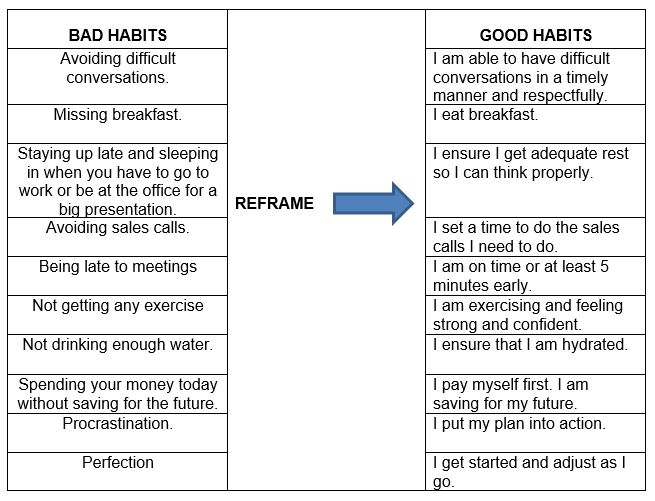
Some of the bad habits you may have will be listed on the left-hand side and on the right side of the table you will notice ways to reframe them. Talk about how you can shift your bad habits and change them so you can put in more productive ways to improve the habits that you have so you can achieve success that you want. If habits determine your future, it is really important to dig deep, get self-aware and find out what could be holding you back from the success that you desire.

badhabitsandgoodhabits
REFRAME GOOD HABITS Avoiding difficult conversations.I am able to have difficult conversations in a timely manner and respectfully.Missing breakfast.I eat breakfast.Staying up late and sleeping in when you have to go to work or be at the office for a big presentation.I ensure I get adequate rest so I can think properly.Avoiding sales calls.I set a time to do the sales calls I need to do.Being late to meetingsI am on time or at least 5 minutes early.Not getting any exerciseI am exercising and feeling strong and confident.Not drinking enough water.I ensure that I am hydrated.Spending your money today without saving for the future.I pay myself first. I am saving for my future.Procrastination.I put my plan into action.PerfectionI get started and adjust as I go.

We talk about smoking and retail therapy – not only can they be a habit but also an addiction to fulfill a need.

At the end of the day, it is all about making a behavioral change. When we think about a changing behavior, we think “No it is not me who needs to make a change, it is the other person who has to change.” The only person you have control over is you and what you are doing for yourself.

Good habits are … see the reframing in the table above.

Imagine if you procrastinated on taking out the trash. Things would get a little stinky and smelly. The same thing happens with life situations, if you do not tend to them or nurture them- it can get out of hand.

Do what you need to do and get it out of the way.

A bad habit has a consequence. Missing breakfast today might not seem like a big deal but if you are missing it or having additional chocolate or extra portions, the consequences won’t be seen today. They are seen in the future – years down the road like with smoking and lung cancer. The consequences are not seen right now.

TMW_PDFclickhere.fwGood habits can be taken for granted – the healthy eating, going for a walk, walking the dog, or protecting yourself from the sun. These are all things to initiate good habits – good hygiene for example.

Look for the patterns. What are your bad habits? Identify them and write them down. Review your habits and think about 1-2 things you would like to make a plan to change. Financial. Exercise. Your Health. Once you create a plan, get help from someone who has a specialty in that area – someone you trust  or great knowledge to help you develop a change. You might a grab a book from the library or bookstore to help you develop a change.

Remember no one can make you change. The change needs to come from within. For example, let’s say weight loss is a subject. It is about gathering those resources and asking those questions. You could have a dietician come on board. You could have an exercise specialist or trainer. Grab some cookbooks from the bookstore. Learn how to cook differently. You may do research online Make sure you are going to credible websites because it seems like everyone is giving out advice.

Your habits will determine your future. What are 1-2 habits you would like to change in the next 30 days?

It is like a goal. We have a time stamp. We will re-evaluate in the next 30 days. Think about the strategies and make a plan for how you are going to make the change. How are you going to be held accountable?

The other things that can be seen as habits are: not brushing your teeth, not speaking up or making a request in the office, not making those sales calls, or doing the follow up with the people you met at the networking event. These are all habits that affect the success and the results you are getting.

The only way to change what you are doing is to ask:

  • What is working?
  • What is not working?
  • What do I need to improve?

Look at your habits and pick 1-2 that would have the greatest impact right on your life right now. We all have habits. When we take the time to reflect and we are self-aware of them that is when we can start creating the change.

When you show up and be the change in the world, you change the world around you. You may say, “Wow! Everyone changed!” Guess what? The change is actually YOU! It is one of the most powerful transformational changes that could be helping propel yourself forward. Take those habits and break them down into smaller pieces. What are you going to do this week? Today? Maybe you need to find an app for entering the data for how many glasses or water you drank or how many sit-ups you did. You may consider using a journal to track things.

Think about all the little things. The little things really affect the big picture.

DEBRA KASOWSKI, BScN CEC is an award-winning best-selling author, transformational speaker, blogger, and Certified Executive Coach. She has a heart of a teacher and is certified in Appreciative Inquiry and Emotional Intelligence. Her writing has been published in a variety of print and online magazines. Debra Kasowski International helps executives, entrepreneurs, and organizations boost their productivity, performance, and profits. It all starts with people and passion. Sign up the Success Secrets Newsletter and get your free mp3 download today! www.debrakasowski.com


Time 11:12 min

Filed Under: Podcasts Tagged With: behavior change, habits, lifestyle change, motivation, success

EPISODE 4 : Receiving Feedback

June 29, 2016 by Debra Kasowski Leave a Comment

https://media.blubrry.com/themillionairewomanshow/content.blubrry.com/themillionairewomanshow/Episode_4_-_Receiving_Feedback.mp3

Podcast: Play in new window | Download

Subscribe: RSS

We receive feedback all around us every day. This is the world telling us about what’s going on – you receive feedback when you step on a scale or when you pick up the phone. Some feedback is direct and some feedback is in the direct.

Feedback can help us figure out if we are on the right track or the wrong track.

A quote that resonates with me when I think about feedback by Thomas A. Edison, “ I had not failed I have just found 10, 000 ways that won’t work.”

When you get the feedback you can adjust as you go. You can decide whether the feedback has validity and whether or not it is something you want to integrate into what you do on a regular basis.

There are a lot of courses on how to deliver effective feedback but there isn’t a lot of information on receiving feedback. I came across the book, Thanks for the Feedback: The Science and Art of Receiving Feedback Well by Douglas Stone and Sheila Heen and it’s a New York Times Bestseller – very powerful. They are also co-authors of another great book called Difficult Conversations.

There are three forms of feedback according to Heen and Stone/;

  • Appreciation – which everyone loves – kudos, the praises, and the high fives.
  • Coaching – Coaching is meant is for improvement
  • Evaluation – Evaluation is seen as judgment – that is when people can become standoffish because if an evaluation is good, “they are like oh – great!” then we are back to appreciation. If they see the evaluation as bad, they feel like what they bring to the workplace or the business front is not recognized and appreciated.

An example of a time when I was coaching someone they thought I was going to come from a place of evaluation and that they would be in trouble for someone. So I said “No, no, no. I am here with the intention of coaching.” We took a step back and I talked about the three types of feedback and that my intent was to from a place of being a coach, “I am here to help you improve and offer suggestions.” At the end of the day, the receiver of the feedback decides whether or not they are going to accept the feedback or not. It changed the whole tone of the conversation. Instead of that person thinking I was making a judgment about their performance, we were able to further discuss how we were going to use this information.to improve for the next time. If the giver and receiver are not on the same page, you will start noticing tension and misunderstanding which can lead to difficult conversations.

If you ensure that your receiver is understanding what you are trying to deliver, (if you are the delivering the feedback) it makes the feedback ready to absorb.

You may be asking yourself, “When is a good time to deliver feedback?” The things you need to keep in mind is that not everyone likes to receive feedback publicly or likes to be coached in front of their peers. One of the things that I find works very well, if you can step aside and go to a quiet area or behind closed doors, so you can have this conversation so the person you are talking with can be very candid and allow for the vulnerability – that deep conversation.

You want to start off by listening for what the receiver hears from the feedback. When you are delivering the feedback, you can remind them from what place you are coming from, appreciation, coaching, or evaluation. Once you make you make that clear, ask to make sure that the receiver knows that. As the receiver, if you are unsure as to where this feedback is coming from you have your own responsibility of saying, “Hey, this is what I am hearing, are you trying to coach me or are you trying to pass a judgment? Because what I am hearing is this…” This makes a huge difference in these conversations and could really avoid any misunderstandings.

TMW_PDFclickhere.fwThink about how you receive feedback and don’t be afraid to offer feedback in reflection. Something Marshall Goldsmith encourages is Feed Forward – offer suggestions and improvements of what can be better next time. An example he likes to use is to imagine someone did a presentation in a meeting and they did not do a very good job. People were nodding off, distracted and started playing on their phones. It was not well received and instead of telling the person that the meeting did not go well. The FeedForward approach is about offering them suggestions of what they could do better the next time and having the open discussion. Most of the time if the person is self-aware they are going to know if it did not go well especially if they were able to read the room. Instead, of reminding them and rehashing the obvious, let’s talk about how we can make it better. Always focus on the positive side and moving forward.

Think about how you have received feedback before. I myself, while I was reading this book, I had a family situation come up. I was like “Why is this person telling me what to do?” I actually got a little bit defensive and a little bit upset with it. As I was reading the book, I actually took a step away to go to a quiet space to read this book. My ah-ha was “Oh, okay, I get it. Even though they said this, I did not have to accept it. They were offering me feedback without knowing the whole context of the situation. They came in part way and did not think about it. I asked myself, “Were they trying to make a judgment or offer me some improvement?”

I decided to take it as some improvement. So I thought okay – I am not going to let it bother me. It was easier to let it go and move forward. I do not want to be holding grudges and I hope that you don’t either. Because these things hold us back from getting the success that we want. Every time you see that person you will think of that situation and all it becomes is a weight – a weight on your back that stops you from moving forward. If you want to achieve success, you cannot have grudges. You cannot hold onto the past. You need to be able to move forward, learn the lessons that you need to, and see if there is valid information from the information you receive.

Use the feedback you receive to your advantage. Is there some truth to the feedback you are receiving? Is there something you can do with it? Is there something you need to stop doing? Adjust your course as you go – soon enough you will be on the right path to your success.

DEBRA KASOWSKI, BScN CEC is an award-winning best-selling author, transformational speaker, blogger, and Certified Executive Coach. She has a heart of a teacher and is certified in Appreciative Inquiry and Emotional Intelligence. Her writing has been published in a variety of print and online magazines. Debra Kasowski International helps executives, entrepreneurs, and organizations boost their productivity, performance, and profits. It all starts with people and passion. Sign up the Success Secrets Newsletter and get your free mp3 download today! www.debrakasowski.com

Time 10:15 min

Filed Under: Podcasts Tagged With: appreciation, coaching, Delivering Feedback, evaluation, feedback, giving feedback

EPISODE 3: Set Goals That Stretch You

June 29, 2016 by Debra Kasowski Leave a Comment

https://media.blubrry.com/themillionairewomanshow/content.blubrry.com/themillionairewomanshow/Episode_3-_Set_Goals_that_Stretch_You.mp3

Podcast: Play in new window | Download

Subscribe: RSS

Step Out of Your Comfort Zone

One of the big things about setting goals is that people don’t dream big enough. They sit back and wonder what is possible for them. Tony Robbins said, “Setting goals is the first step in turning the invisible into visible.”

One of the things you need to do is really decide what it is that you really want. What I have found when I work with individuals that they have never stopped long enough to take time for themselves, “You know what, what is it I truly want?”  They get so involved in the hustle and bustle of life that they get carried away with the next big thing or they are doing what that their mom or dad told them to do. It seemed like the natural thing to do but instead they need to step into who they are. They had their life experiences to bring this point to be able to make the decision of what they want.  If they are unsure of what they want, set aside some and maybe even have a friend beside you ask you “What do you want? What do you want? What do you want? Repeatedly 10-15 minutes until you fill the pages or a journal or a page at least until you figure out what you really want.

I did this exercise with someone at a coffee shop and I kept saying, “What do you want? What do you want? What do you want?”

She said, “Alright already!” She wanted to get married in Jamaica.

Then I asked her, “How much does it cost to go to Jamaica?”

She said, “I have no idea.”

I looked at her and said, “How do you know that the dream is not possible already?”

She had a partner. She wanted to have this big dream but she didn’t do some of the leg work involved.

A few years later I have received an invite that she was getting married in Jamaica!

TMW_PDFclickhere.fwUnfortunately, I was unable to go but it was exhilarating to me that she fulfilled a dream that was important to her.

Get clear on what you want to achieve. What would you like to BE, DO, or HAVE?

Once you gave an idea of what it is you want, you can share it with people who you can trust who are going to be there to support you. Otherwise, keep it to yourself if you need to but if it something like weight loss or other things it sometimes helpful to have a person to keep you accountable and do the work with you like going to the gym or doing a road race. Having an accountability buddy is helpful. If you have people who are going to talk you out of it or question whether or not you can do something, don’t let them stop you. The only person who needs to believe in your vision for yourself is YOU. When you believe in yourself you make the possibilities happen. We can’t sit around waiting for someone else.

Decide on 1-3 goals short term goals (30-90 days) and 1-3 long-term goals (6- 12 months). Avoid setting too many goals so you do not feel overwhelmed. If you have way too many, you will not even know which one to start on! The goal is not important to me anymore. Start with 1-2 goals for right now! Start slow! Create your own action log!

Write out a SMART goal. If you INK it, you will THINK it.

S=Specific – What do you want to achieve?

M = Measurable – How will you measure it so you know you have achieved it? E.g. Rating Scale

Sometimes people get stuck on this one. If you care thinking about an action – something you can measure that is easy but if it is based on how you perceive or feel about something a rating scale would be better.

On a scale on 0 -10 you feel a 3/10 and you want to feel 6/10 in 2 weeks (as an example). What strategies will you put in place to do this?

A= Achievable – Can you achieve this goal with the resources you have? Do you need to ask for help? Do you need to delegate something?

R=Realistic – Is this goal something that you can actually accomplish?

T=Timely – In what time frame do you wish to achieve this goal?

“A goal without a deadline is just a wish.” Antoine de Saint-Exupery

Make sure that you put a deadline to it, hold yourself accountable, and reward yourself along the way. Don’t be afraid to dream big!

Tom Landry said, “Setting a goal is not the main thing. It is deciding how you will go about it, achieving it, and staying with that plan.”  You know that there will be test along the way and distractions but it all comes down to how committed you are to making your goal come true.

Break your goal into small manageable pieces or mini goals. What are the strategies or action steps do you need to take daily, weekly, or monthly? Is there anything you need to delegate? What resources of time, money, or people do you need?

Break it down into a chart. It works really well if you are a visual person.

Review and track your goals daily, weekly, and monthly. Adjust as you go. Keep taking intentional action to create momentum. If you create momentum, you with be motivated no matter what obstacle may arise! Remember to celebrate your successes because they will remind you how far you have come!

DEBRA KASOWSKI, BScN CEC is an award-winning best-selling author, transformational speaker, blogger, and Certified Executive Coach. She has a heart of a teacher and is certified in Appreciative Inquiry and Emotional Intelligence. Her writing has been published in a variety of print and online magazines. Debra Kasowski International helps executives, entrepreneurs, and organizations boost their productivity, performance, and profits. It all starts with people and passion. Sign up the Success Secrets Newsletter and get your free mp3 download today! www.debrakasowski.com

Time: 9:04 min

Filed Under: Podcasts Tagged With: coaching, comfort zone, goals, goals setting, motivation, personal development, SMART goals

  • « Previous Page
  • Page 1
  • …
  • Page 124
  • Page 125
  • Page 126
  • Page 127
  • Page 128
  • …
  • Page 200
  • Next Page »
  • Terms of Use
  • Privacy Policy

Copyright © 2026 · Aspire Pro on Genesis Framework · WordPress · Log in